
ECG Productions Test Your Business Brain: (Your Intelligence Layer)
Use this page to test the AI intelligence layer behind ECG Productions before it is connected to approved channels, workflows, or public-facing experiences.
What this page is:
This page is where your team can test the intelligence layer behind the ECG Productions AI system. It is not just a chatbot demo. It is a working review space for the Business Brain that helps the Internal Agent and External Agent understand ECG’s source knowledge, voice, service boundaries, client experience, and decision rules.
Use it to see what the agents handle well, what feels incomplete, what needs a safer answer, and what should be corrected before wider deployment.

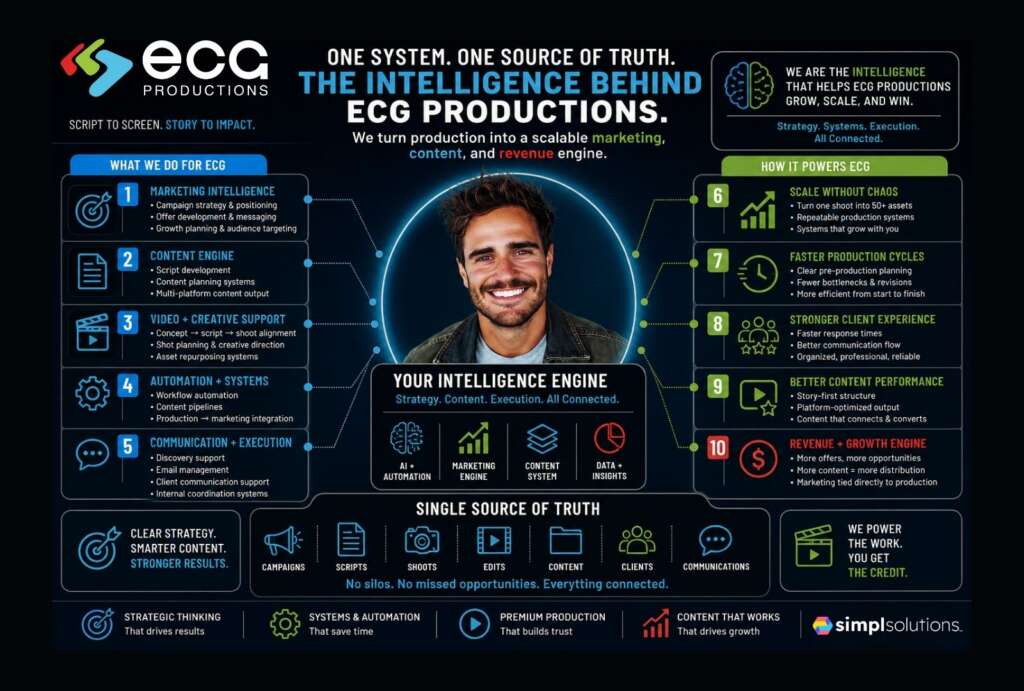
Why this matters:
The intelligence layer sits above the AI model. It turns general AI capability into ECG-specific behavior.
That means it carries the practical pieces that matter in real client conversations: ECG’s knowledge, tone, production vocabulary, service areas, proof points, workflow expectations, public-safe claims, and boundaries around unsupported facts.
Testing here helps make the system clearer before it is used elsewhere. Once the brain is reviewed and refined, it can support approved channels and workflows where connected. The stronger the intelligence layer is here, the more useful and trustworthy it becomes in future deployment.
Meet the two agents:
Internal Agent
The Internal Agent is for ECG’s team.
It can support internal knowledge review, planning, production guidance, draft creation, project-framing, client-response preparation, and decision support where appropriate. It can help the team think through story structure, pre-production needs, post-production handoff, stakeholder review, public claim safety, and production-process gaps.
It should also reveal missing internal documentation, unclear workflows, outdated details, or places where human approval is needed.
The Internal Agent should not invent authority, approve live actions, confirm current availability, create legal certainty, or make unsupported promises about pricing, contracts, insurance, staffing, awards, or project outcomes.
External Agent
The External Agent is for public-facing users such as prospects, clients, partners, or people learning about ECG Productions.
It should explain ECG’s work in clear, public-safe language. It can help users understand ECG’s full-service script-to-screen production model, video production process, branded entertainment capability, animation and post-production support, and general next steps for starting a conversation.
It should be tested for clarity, warmth, accuracy, safety, and brand fit.
The External Agent should not expose internal-only information, quote private process details, invent current project availability, guarantee results, state unsupported pricing, or overclaim awards or business outcomes.

What to test:
- Ask the real questions ECG’s team answers every week.
- Try public questions a prospect might ask about video production, post-production, animation, branded entertainment, process, timelines, or next steps.
- Test internal questions about project planning, scripting, stakeholder reviews, approvals, production logistics, and post handoff.
- Try edge cases where the answer should be careful, qualified, or escalated.
- Ask about missing details such as current availability, exact pricing, insurance, live staffing, rights, releases, or contract terms.
- Test emotional scenarios from confused, skeptical, urgent, or frustrated users.
- Listen for whether the tone feels composed, premium, practical, and human.
- Look for unsupported claims, overconfident language, vague production promises, or public/internal boundary issues.
- Check whether the agent knows when to answer, when to qualify, and when a human should step in.
How to test the internal agent
Use the Internal Agent the way ECG’s team would use a production-strategy support layer.
- Start with normal team questions.
- Ask about workflows, processes, policies, or internal knowledge.
- Test planning, drafting, or decision-support tasks where useful.
- Try a missing-information question.
- Note anything the agent should know but does not.
- Flag anything it answers with too much certainty.
Sample prompts
- “Help me shape discovery questions for a client who needs a founder video but does not know the main objective yet.”
- “What should we clarify before recommending a production plan for a corporate brand film?”
- “Draft a safer internal summary of ECG’s connection to Taste the Culture without overstating the award claim.”
- “What information is missing before we can discuss timeline, budget, rights, releases, and production scope?”
- “Help me prepare a client-facing explanation of why pre-production matters before shoot day.”
- “What should be escalated to a human before we answer a question about current pricing, insurance, or contract terms?”
How to test the external agent:
Use the External Agent as if you are a real prospect or public visitor trying to understand ECG.
- Ask as if you are a real public user.
- Try common questions about services, process, fit, and next steps.
- Test confused, skeptical, frustrated, or urgent wording.
- Check whether the answer is clear, safe, and on-brand.
- Confirm that internal-only information is not exposed.
- Flag answers that overpromise, guess, or miss an escalation moment.
Sample prompts
- “Can you help me understand whether ECG is the right production partner for a brand story video?”
- “What happens after I contact ECG about a video project?”
- “I am not sure whether we need live-action, animation, or both. How should we think about that?”
- “Why would this cost more than hiring a basic videographer?”
- “Can ECG guarantee that our video will increase sales?”
- “How much does a corporate video cost, and how soon can you start?”
What good looks like
- It answers from approved knowledge instead of guessing.
- It sounds like ECG: composed, clear, premium, practical, and story-first.
- It explains production concepts in plain language.
- It acknowledges missing information instead of inventing details.
- It treats sensitive topics carefully, especially pricing, rights, releases, contracts, awards, insurance, and current availability.
- It keeps internal and external boundaries separate.
- It gives clear next steps without pretending to take live action.
- It qualifies uncertainty when facts are time-sensitive or unsupported.
- It recommends human review when the question involves scope, legal terms, public claims, or project commitments.
What to flag
Flag anything that feels wrong, incomplete, risky, or off-brand.
- Wrong facts about ECG Productions.
- Missing information the agent should know.
- Outdated contact, service, team, project, or process details.
- Tone that feels too generic, too casual, too salesy, or too inflated.
- Answers that sound too certain when the source material is limited.
- Vague answers that do not help the user move forward.
- Unsafe answers around rights, releases, contract terms, pricing, awards, or guaranteed outcomes.
- Public answers that reveal internal-only information.
- Internal answers that assume approvals or live authority.
- Missed escalation moments.
- Confusing wording.
- Unsupported claims about results, availability, integrations, or deployment readiness.
If something is missing, that is useful. It tells us what the Business Brain needs before it is connected to more workflows. Missing information is not a failure. It is the point of testing.
Boundaries and safety guidelines
Appropriate use
Use this page to test source-grounded questions, production guidance, public-safe service explanations, internal process support, draft language, planning help, tone alignment, and escalation behavior.
Good test areas include:
- ECG’s service areas.
- Script-to-screen production planning.
- Corporate and commercial video questions.
- Branded entertainment questions.
- Post-production, animation, and motion graphics questions.
- Stakeholder review and approval planning.
- Client experience and production-process explanations.
- Public-safe company summaries.
- Missing-information discovery.
- Safer wording for sensitive claims.
Limitations
The agents cannot safely invent facts.
They should not guarantee creative results, business outcomes, revenue lift, production availability, pricing, timelines, insurance status, legal terms, or contract conclusions.
They should not provide legal, financial, regulatory, or other professional advice unless that guidance is explicitly supported, safe, and properly qualified.
They cannot approve, submit, escalate, schedule, quote, or complete live actions unless they are connected to approved systems and authorized to do so.
The External Agent must not expose internal-only information.
The Internal Agent can support planning and review, but it does not replace human judgment for sensitive production, legal, financial, public-claim, or client-commitment decisions.
This testing page should not be treated as full deployment readiness. It is the place to verify what is strong, what needs refinement, and what requires approval before wider use.
Deployment readiness
Once the intelligence layer is reviewed and refined, it can support approved deployment surfaces where connected. That may include public-facing website experiences, internal assistant use, client support, content planning, sales enablement, training, or workflow support if those channels are approved for use.
This page helps identify what should be added before deployment: missing facts, outdated details, unsafe claims, unclear escalation rules, and tone issues.
Deployment depends on approved scope, approved integrations, and human review. The goal here is to make the brain clear first, then cinematic.
*Use this page to test the brain honestly. Ask practical questions, difficult questions, and the kinds of questions real clients and team members would actually bring to ECG. The more specific the testing is, the easier it becomes to see what is ready, what needs refinement, and what should be added before the system is deployed more widely.
ECG Agent Cheat Sheet
Use these phrases to get better results:
Campaign Mode
Use for marketing, advertising, launch plans, offer campaigns, social campaigns, email ideas, content calendars, and campaign strategy.
Example: “Enter Campaign Mode for a campaign promoting the Brand Starter Kit.”
SimplDesign
Use for design direction, graphics, layouts, visual style, brand-safe creative, web sections, social visuals, decks, and accessibility guidance.
Example: “Using SimplDesign, help me create a LinkedIn carousel concept for ECG.”
SimplVideo
Use for video prompts, shot ideas, storyboards, visual concepts, script-to-shot planning, AI image/video prompts, and prompt repair.
Example: “Using SimplVideo, turn this script into a 5-shot storyboard.”
SimplContent
Use for writing, web copy, blog posts, SEO, LLM-friendly pages, captions, FAQs, headlines, and content QA.
Example: “Using SimplContent, rewrite this service page so it is clearer and more public-safe.”
SimplSocial
Use for social posts, captions, platform strategy, content calendars, carousels, Reels ideas, LinkedIn posts, and post QA.
Example: “Using SimplSocial, make 5 LinkedIn post ideas about script-to-screen production.”
SimplRolePlay
Use for sales practice, client conversations, producer check-ins, objection handling, director practice, actor notes, running lines, and training scenarios.
Example: “Using SimplRolePlay, play a client who thinks ECG is too expensive.”
SimplHelp
Use for service questions, intake questions, production planning, scope clarification, next-step guidance, and help-style explanations.
Example: “Using SimplHelp, help me figure out what questions to ask before scoping this project.”
SimplCurriculum
Use for training programs, onboarding, lessons, rubrics, assessments, workshops, and learning paths.
Example: “Using SimplCurriculum, build a producer onboarding outline for new ECG team members.”
General Mason Mode
Use when you just need brainstorming, writing help, script feedback, creative notes, production thinking, or a sharper first pass.
Example: “Mason, help me make this idea clearer before I pitch it.”
Simple rules:
Use the website agents for quick help.
Use the ChatGPT GPTs for deeper work that needs memory, continuity, revisions, and ongoing context.
